PRINT
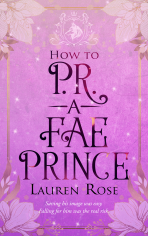
She fixes reputations for a living. He’s a fae prince in crisis. Saving his image is easy. Falling for him is the real risk.
Fortuna Hart manages crises for a living. The kind with cameras, angry headlines, misinformation spirals, and people yelling online before anyone has the full story. She is very good at it. Alarmingly good.
So when a fae prince becomes the center of a very public interdimensional mess, Fortuna is hired to do what she does best. Control the narrative. Keep the city calm. Stop a political headache from turning into a public safety disaster.
Prince Matteo Veyron is powerful, polished, and deeply unimpressed with human crisis communications. He prefers diplomacy to livestreams and ceremony to transparency. He is also distracting, infuriatingly competent, and far too interested in Fortuna’s methods for her comfort. As disinformation spreads and tensions rise between fae and human communities, Fortuna and Matteo are forced into close collaboration. Press conferences blur into late-night strategy sessions. Professional boundaries get…flexible. Even Ravioli, Fortuna’s extremely judgmental dog, seems to sense something is happening and would like it noted for the record.
When their working relationship turns personal and very public, the stakes escalate fast. Every decision is scrutinized. Every glance risks becoming a headline. And falling for a fae prince may be the one crisis Fortuna can’t spin her way out of.
She can handle magical disasters, hostile councils, and live broadcasts in 4K.
Trusting her heart is the part she did not plan for.
How to PR a Fae Prince is a smart, sexy romantasy packed with sharp banter, workplace tension, interdimensional politics, public-facing chaos, and a romance built on competence, mutual respect, and chemistry that refuses to stay behind the scenes.
General Release Date: 20th October 2026
The triple-ping of a StarPing emergency alert at six-fourteen a.m. sounded like the universe personally declaring war on my Tuesday morning.
I bolted upright, heart hammering, reaching for my phone before my brain fully came online. In crisis communications, I’d learned quickly that emergency alerts at dawn mean someone’s day was about to get spectacularly worse, and it was probably going to be mine.
Incident flagged, auditory disruption, potential ward breach. Location, Runewalk District, Downtown. Priority, High. Please respond immediately.
“Shit.” I jumped out of bed, mind immediately cataloging the implications. Runewalk District. Concordia Festival week. Peak political sensitivity.
From the bedroom doorway came the distinctive thump-thump-thump of a tail against the wall. Ravioli, my sixty-pounnd, white-and-fawn pit bull mix with a blocky head and the persistence of a social media notification, appeared with her patented ‘crisis means walkies, right?’ expression.
“Sorry, girl. This one’s work.”
She responded by collapsing onto her back and deploying the full puppy-eye offensive.
I sighed. “This is emotional manipulation. And it’s working.”
I clipped Ravioli’s harness on as she did her happy dance, then threw on what passed for my work armor—charcoal slacks, a cream blouse, a moss green blazer Maya swore brought out my eyes, and block heels sturdy enough for a bad morning. Which, statistically, this was about to be.
Fifteen minutes later, we were booking it downtown. Ravioli trotted beside me, already on full alert, nose twitching as if she was tracking the magic herself.
My phone buzzed constantly with texts from Maya, missed calls from the mayor’s office, notification after notification as StarPing users flooded the system with reports. I scanned them while walking, already building a mental framework.
Horrible screaming from downtown, sounds like someone’s dying.
Windows shaking on Silverleaf Ave, earthquake?
Whatever’s making that noise needs to STOP. My baby won’t stop crying.
Classic panic cascade. One genuine incident triggered dozens of secondary reports from people who heard something unusual and assumed the worst. This was exactly why we built StarPing’s incident cataloging system—to separate real emergencies from neighborhood anxiety spirals.
I fired off a quick message to my team.
Almost to Runewalk. This one’s messy. Maya, keep an eye on everything. Elena, pull the disinfo playbook just in case. Tariq, please consult whatever gods, Fates, or higher powers you’ve offended and make sure our tech works today.
StarPing let residents flag problems straight to the city. Text, web, app, whatever’s fastest. Humans used it like an alert system. Fae used it like a polite summons. Either way, it got my attention.
The response side took longer to get right. Half a year of beta testing had taught us that magical incidents don’t follow the same rules as human emergencies. You can’t send regular paramedics to treat someone who’s been pixie-dusted, and human police don’t know how to de-escalate a territorial dispute between brownies and garden sprites.
Three years ago, when Starwyn became one of the first test cities for the Concordia Accords, a single pixie swarm in the park had people calling in everything from ‘fairy invasion’ to ‘glittery terrorists’. It wasn’t just panic. Something had gone thin between worlds that day, a small fracture no one wanted to name. The Accords promised integration, fae and human communities sharing the same space under binding interrealm law, but it quickly became clear that vision was only as good as our ability to manage it in real time. We needed something better than hoping humans and fae would figure it out as they went along.
Not that the Concordia Council saw it that way when they spent four months dissecting our beta test data. The Council, the fae governing body that oversaw treaty compliance and fae interests in integration sites, had opinions about everything from how we sorted incidents to whether our interface properly respected traditional fae aesthetic preferences. Never mind that Starwyn officials were the ones managing real crises while they held committee meetings about theoretical risk.
Runewalk District was Starwyn’s compromise neighborhood. Victorian brownstones standing shoulder-to-shoulder with buildings that shift when you’re not looking directly at them, cobblestone streets enchanted to be easier on modern shoes while maintaining their historical charm. It’s where most fae-human integration happens organically, which means it’s also where most of our problems start.
This morning, that carefully balanced charm was thoroughly disrupted.
A shimmering figure hovered thirty feet above the main intersection, translucent and warping like heat distortion cranked to eleven. The creature, clearly unsettling and definitely not on any guest list, keened in a voice that rattled windows and set every car alarm within a four-block radius wailing in harmony. The sound wasn’t just loud. It was wrong, like when your audio cuts out during a video call but somehow gets worse.
The air felt tight against my chest as I stopped at the edge of the containment perimeter and pulled out my tablet to document the scene. Everything looked right. Council fae wardens in silver and blue moved in careful formation, refracted barriers sealing off the intersection, emergency services positioned at a safe distance.
I narrowed my eyes.
A banshee.
In downtown Starwyn.
During the opening week of Concordia Festival.
If the Hells were paying attention, they’d nailed the timing.
But where most people would see chaos, I saw opportunity. One bad brand rollout years ago had taught me that if you don’t shape the story, someone else will. Channel Seven’s news van had just pulled up on Maple Street. I hit call on the one person I trusted to help me get ahead of it.
“Maya, I need you to monitor all media feeds starting now. If this goes viral before we control the narrative, we’re screwed.”
“Already on it!” confirmed Maya Patel, my communications specialist, best friend, and the only person who could rewrite public perception faster than I could order her favorite moonberry crullers. “Elena’s tracking socials, Tariq’s got broadcast warm-ups rolling. What are we dealing with?”
I studied the scene, noting the wardens’ formation, the way they were containing rather than banishing, and the almost mournful quality to the banshee’s wailing. This wasn’t random magical mayhem. This was structured. Purposeful. If I was reading the containment pattern correctly, the wardens thought so, too.
“Helpful supernatural intervention being misinterpreted as a threat. Standard Tuesday morning in magical municipal management. But someone’s coordinating this response really well. The containment formation is Council-level professional.”
My gaze swept the scene, looking for whoever was running point.
That’s when I saw him.
The Caelwilk fae warrior stood dead center of the response zone like he’d claimed it without asking. Too tall, too still, wrapped in a midnight blue coat that blurred the line between uniform and indulgence. It wasn’t ceremonial, but it wasn’t civilian either. Structured shoulders, sharp seams, fabric that caught the light wrong, too sleek to be human, too restrained to be ornamental.








 Add to Wishlist
 Read a Sample
 Send as a Gift